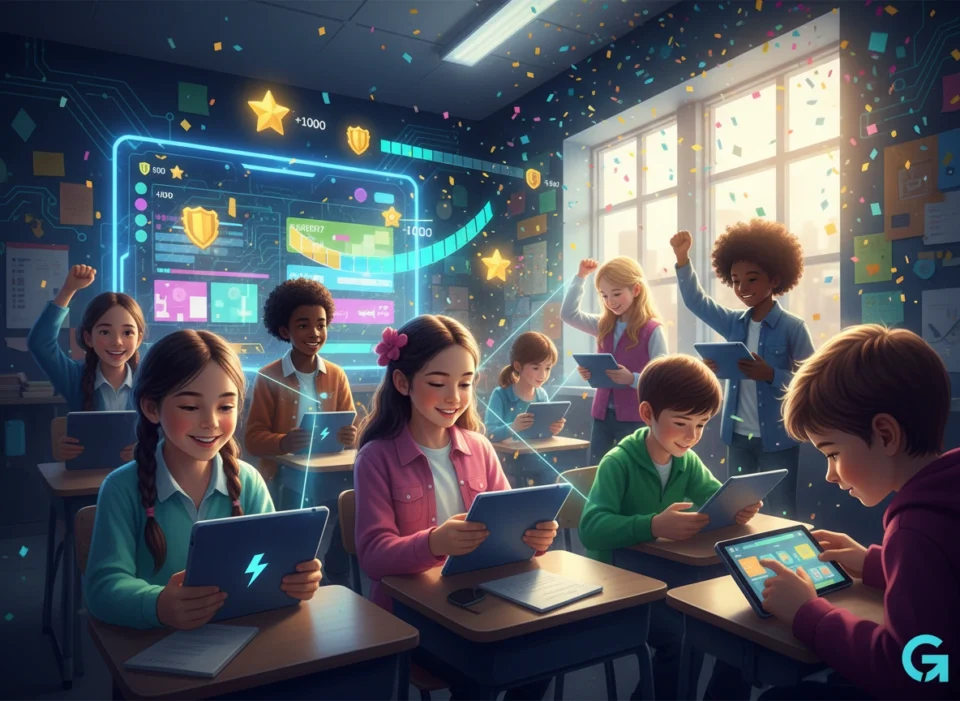
Walk into almost any modern classroom, and you might see students glued to screens, not because they are distracted, but because they are fiercely competing to earn virtual currency. This is the new face of review day, powered by platforms like Gimkit.
Gamification in education isn’t just about making school “fun.” It is a strategic approach to pedagogy that leverages game mechanics to boost engagement and, more importantly, retention. Among the tools available to educators, Gimkit stands out. Created by a high school student who felt classroom games were becoming stale, it introduces unique economic mechanics and high-stakes strategy that keep students returning to the material repeatedly.
This article explores how Gimkit transforms standard review sessions into high-impact learning experiences, specifically focusing on the mechanisms that drive long-term knowledge retention.
The Science of Gamification and Retention
Before diving into Gimkit specifically, we need to understand why gamification works. It is not merely about points and badges. Effective gamification taps into core psychological drivers: motivation, immediate feedback, and the desire for mastery.
Active Recall and Spaced Repetition
Two of the most powerful study techniques for retention are active recall (testing yourself) and spaced repetition (reviewing material at increasing intervals). Traditional studying often relies on passive review, like re-reading notes, which has low retention rates.
Gamified platforms force active recall. To progress in the game, a student must answer a question. If they get it wrong, the game ensures they see that question again soon. This creates a loop where knowledge is constantly tested and reinforced.
The Dopamine Loop
Video games are addictive because they trigger dopamine release through achievement and reward. When a student answers a question correctly in a game, they receive immediate validation. This positive reinforcement encourages them to continue the behavior (answering questions). Over time, this builds a positive association with the learning material itself.
What Sets Gimkit Apart?
While platforms like Kahoot! and Quizizz paved the way, Gimkit introduced a different layer to the genre: strategy and economy.
In a typical quiz game, speed and accuracy are the only variables. In Gimkit, students answer questions at their own pace to earn in-game cash. They then use this cash to buy upgrades and power-ups. This economic layer changes the dynamic entirely.
The “Kit” in Gimkit
The platform was built by Josh Feinsilber as a high school project. His goal was to fix the engagement drop-off he saw in other games where students who fell behind early had no chance of winning. In Gimkit, a student can answer questions, buy a multiplier upgrade, and suddenly surge from last place to first. This hope keeps students engaged for the entire session.
Core Features Driving Retention
Gimkit’s design directly supports learning retention through several specific mechanics.
1. Repetition Without Monotony
In a standard worksheet, a student answers a question once and moves on. In Gimkit, questions cycle. A student might answer the same question 10 or 15 times in a single session.
This might sound boring, but the context changes. The first time they answer, they are earning $1. The fifth time, they have purchased a “Streak Bonus” and are earning $100. The tenth time, they are trying to protect their earnings from another player using a “Reducer” power-up.
Because the motivation (earning money for upgrades) remains high, students don’t mind the repetition. This massive volume of repetition cements the facts in their long-term memory.
2. High-Stakes Decision Making
Retention improves when learning is connected to emotion and stakes. Gimkit asks students to manage resources. Should they spend their cash on an insurance upgrade to protect against wrong answers? Or should they risk it all on a mega-bonus?
When a student answers a question wrong in Gimkit, it can cost them money. This “loss aversion” makes them pause and think. Unlike games where speed is everything, Gimkit rewards accuracy and strategic investment. This deeper cognitive processing aids memory encoding.
3. Immediate Corrective Feedback
When a student gets a question wrong in Gimkit, the correct answer is displayed immediately. Furthermore, the game’s algorithm ensures that the missed question reappears shortly. The student is forced to confront their gap in knowledge and correct it to continue earning efficiency. This closes the feedback loop instantly, preventing misconceptions from taking root.
Classroom Application: From Review to Mastery
Teachers across various subjects use Gimkit to turn dry content into dynamic learning environments.
The “Floor is Lava” and Other Modes
Gimkit offers various game modes that change how students interact with the content.
- Trust No One: A social deduction mode similar to Among Us, where students must answer questions to conduct investigations. This links content mastery to social play.
- The Floor is Lava: A cooperative mode where the class must work together to keep the structure above rising lava by answering questions correctly.
These modes shift the focus from individual competition to team survival, fostering peer-to-peer teaching. Students will often shout out, “The answer to number 5 is ‘Mitochondria’!” to save the team. Teaching others is one of the highest forms of retention.
Data-Driven Instruction
For teachers, the backend of Gimkit provides crucial data. After a session, a “KitCollab” or standard report shows exactly which questions stumped the class.
If 60% of the class missed a specific vocabulary term, the teacher knows immediately that re-teaching is necessary. This ensures that the gamification isn’t just a distraction, but a diagnostic tool.
The Benefits for Students and Teachers
The impact of Gimkit goes beyond just test scores; it changes the classroom atmosphere.
For Students:
- Autonomy: They choose their strategy. Do they play aggressively or conservatively?
- Accessibility: Because questions repeat, students with slower processing speeds can still succeed by upgrading their “money per question” stat, leveling the playing field against “fast” test-takers.
- Safety: Failure is part of the game. Getting a question wrong loses virtual money, not actual grade points, creating a low-risk environment for making mistakes and learning from them.
For Teachers:
- Engagement: It captures the attention of the “hard-to-reach” students who typically check out during reviews.
- Ease of Use: Teachers can import question sets from Quizlet or spreadsheets in seconds.
- ** formative Assessment:** It acts as a stealthy quiz, providing real-time data on student understanding without the anxiety of a formal test.
Case Studies and Observations
While formal peer-reviewed studies specifically on Gimkit are still emerging, anecdotal evidence from the education community is overwhelming.
Many educators report that students explicitly ask for “Gimkit time.” One high school history teacher noted that during a Gimkit session on the Cold War, students answered over 3,000 collective questions in 15 minutes. That volume of practice is nearly impossible to achieve with worksheets or traditional flashcards.
Furthermore, the “stickiness” of the platform is evident. Students often remember the answers to difficult questions weeks later because they associate that specific fact with a pivotal moment in the game where they purchased a major upgrade. The emotional anchor of the game helps retrieve the academic information.
The Future of Gamified Learning
Gimkit represents the second generation of classroom gamification. The first generation was about digitizing the quiz. The second generation is about gamifying the system of learning.
As we look forward, platforms like Gimkit are likely to integrate more adaptive learning technologies. Imagine a version of Gimkit that uses AI to generate new questions on the fly based on the specific misconceptions a student is showing during the game.
The line between “studying” and “playing” is blurring. Critics often worry that gamification dilutes academic rigor. However, Gimkit proves that rigor and engagement are not mutually exclusive. By demanding high accuracy and creating a system where knowledge is the currency, it reinforces the value of learning.
Conclusion
Gimkit is more than a flashy distraction. It is a robust retention engine disguised as a game. By utilizing spaced repetition, providing immediate feedback, and empowering students with strategic agency, it ensures that information moves from short-term memory to long-term understanding.
For educators looking to boost retention, the answer might not be another lecture or a thicker textbook. It might be giving students a virtual bank account, a set of questions, and the freedom to play their way to mastery.
Actionable Next Steps
If you are an educator or trainer ready to implement this tool:
- Start Small: Create a free account and try the “Classic” mode with a short, simple question set.
- Focus on Feedback: Use the post-game report to identify the top 3 missed questions and review them immediately while interest is high.
- Empower Students: Use the “KitCollab” feature to let students write their own questions, turning them from consumers of content into creators.
Please visit the official site for more info.
